
100 Market Street
100 Market Street History
· The earliest known record of the lot is as part of a land grant dating back to 1784 filed in Northumberland County. It was sold to John Gundy in 1795
· Purchased by William Hayes, merchant and Postmaster in 1818 (also the year of his father, Robert’s death), this classic federal-style, stone residence was built in 1819 with precision by German stone masons with local limestone from the Susquehanna. The lot included the space currently occupied by Sculptures Studio. Upon the death of William in 1843 the deed was passed to his youngest son James.
· In 1867 the property was sold to Mark Halfpenny. Halfpenny was the owner of a woolen manufacturing operation west of Lewisburg in Laurelton which was founded in 1847 and whose business flourished as a blanket supplier to the Union Army. A fire destroyed the building and he relocated to Lewisburg after the Civil War where he purchased the property now currently occupied by The Street of Shops on Water Street. One of the sellers was Thomas Hayes, eldest son of William who was a partner operating a grain mill there. The Lewisburg Woolen Mills was the largest manufacturer in Lewisburg by the 1870’s and had a reputation for high quality products.
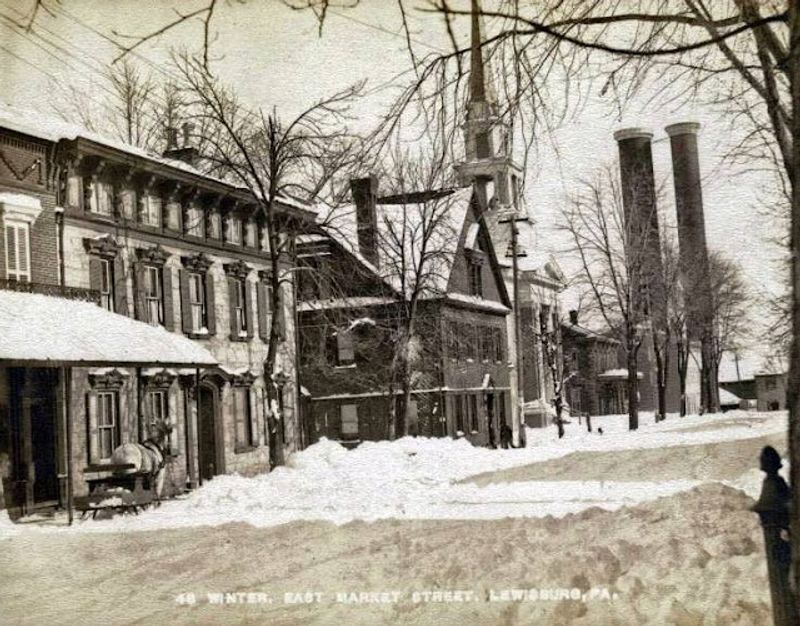
· During the Halfpenny ownership, the residence was extensively modified to include the addition of a third floor. The Halfpennys’ had 9 children and many grandchildren by the late 1800’s. The roof was raised as evidenced by the brick gable fill-ins, the roof slope was altered and windows and decorative cornice were added. A large, additional residence, 100 ½ Market St, was built in the 1870’st at the rear of the property but was absent from the Library of Congress architectural maps by 1920 likely the casualty of a fire.
· The property was transferred to Mark’s son Frank in 1888 -a year prior to Mark’s death. It was transferred again to a series of owners and estates until Bucknell’s Kappa Delta Rho fraternity purchased it in 1926. It is surmised that the fraternity used the third floor for sleeping quarters, the second floor as study space and the first floor for dining and social events utilizing the floorplan of the Halfpenny’s.
· The Bucknell fraternity ownership could not survive the loss of students due to service during WW2. Before a sale, the 3 remaining residents carved their names in the basement timbers. In 1943 Harvey Heimbach purchased the property and sometime thereafter it was converted into apartments (Two, one-bedroom apartments on each of the 2nd and 3rd floors) and an owner-occupied residence on the first floor. At that time the central interior stairwell was eliminated, new access to the upstairs apartments from Front Street was created and the front porch, door and fire escape were added at that time. Title passed to others twice through estates in the 50’s and 60’s.
· In 1972 after the Hurricane Agnes Flood, Charlie and Jean Fisher purchased the property, and the family occupied the first floor while continuing to rent the upper floors. Before purchasing and operating Brendan’s Towne Tavern in Lewisburg, Charlie ran a landscaping business and most of the back yard was developed and planted by him.
· Jim and Susan Mathias purchased the property in 2018 and renovated it extensively.
· The property was acquired by Stillwater Sanctuary LLC in 2015 with plans to use the ground floor as a Med Spa and outdoor event space opening in 2026.
· Other fun facts:
o Between the original flour mill and the later woolen mills the manufacturing structures on the river burned extensively or to the ground 4 times -1847, 1854, 1875 and 1920. Pennsylvania House Furniture acquired the property in 1960
o The lot currently occupied by Sculptures was split off in the later 1800’s. ‘The Directory of Lewisburg Businesses” compiled by Richard A Sauers records the continuity of business in Lewisburg from 1785 to 2016. The Sculptures building is listed as a grocery and market from 1918 to 1975 but we know that a census of the structure shows a dry goods and grocery operation there in 1885. It’s very possible that the split of the property obscured the continuity of operation and general merchandise/dry goods/groceries were sold from this location from a much earlier era, perhaps back to the time of the original owner.